Garage Door Repair in Hopkins MN – Common Problems & Fixes
Last January, a homeowner in Hopkins called me in a panic. She’d left for work at 7 a.m., hit the opener button, and nothing happened. Her car was trapped inside. The temperature outside was -14°F. She had a job interview in two hours.
That kind of moment reveals something important: your garage door is not just a convenience. In Minnesota, it is essential infrastructure. And yet most homeowners don’t think about it until it fails at the worst possible time.
I’ve been working on garage doors in the Twin Cities metro for years. Hopkins, in particular, has a mix of older homes with aging spring systems and newer developments where openers get pushed hard through brutal winters. What I’ve learned is that most garage door problems follow predictable patterns, they have real solutions, and homeowners who understand them save hundreds of dollars every single year.
Let’s walk through what’s actually happening when your door misbehaves, and what you can do about it.
Why Garage Doors Fail More Often in Hopkins MN Than You Might Expect
Hopkins sits in Hennepin County, which means it gets the full force of Minnesota’s temperature swings. We’re talking -20°F winters and 90°F summers. That’s a 110-degree range your door hardware has to survive.
Metal contracts in cold and expands in heat. Springs that were calibrated in a 65-degree garage suddenly have to work harder at -10°F. Lubricants thicken. Sensors fog. Rollers crack. This isn’t bad luck. It’s physics.
The homes west of downtown Hopkins near Shady Oak Lake tend to have older detached garages with original hardware from the 1980s and 1990s. Those spring systems are well past their expected lifespan of 10,000 cycles. Meanwhile, neighborhoods near the Excelsior Boulevard corridor have newer attached garages with more sophisticated opener systems that have their own failure modes.
Understanding which category your setup falls into changes the diagnosis completely.
The Most Common Garage Door Problems Hopkins Homeowners Report
1. The Door Won’t Open or Close
This is the most common complaint I hear. Before you assume it’s the opener or the springs, check three things first.
First, look at your wall button. If the wall button works but the remote doesn’t, you have a remote or receiver problem, not a mechanical one. Try replacing the battery. If that doesn’t fix it, the remote may need to be reprogrammed to your opener. LiftMaster and Chamberlain openers (the two brands I see most often in Hopkins) have reprogramming instructions printed on the back of the motor head.
Second, check whether the door moved manually. Disconnect the opener by pulling the red emergency cord and try to lift the door by hand. If it lifts smoothly, the problem is the opener. If it’s heavy, stuck, or crooked, you likely have a spring or track issue.
Third, check your safety sensors. Those two little boxes near the floor on each side of the door frame, they have to be aligned and unobstructed. If one of them shows a red or blinking light instead of a solid green, something is blocking the beam, or they’re knocked out of alignment. Wipe the lenses with a dry cloth and gently bend the sensor brackets back toward each other until both lights go solid.
I cannot tell you how many service calls I’ve gone on where the sensor fix took 45 seconds.
2. Broken Torsion Springs
Here’s what nobody tells you upfront: a broken torsion spring is the most dangerous DIY repair you can attempt. I say this not to scare you into hiring someone, but because I’ve seen the aftermath when it goes wrong. Torsion springs are under enormous tension. A spring that snaps during improper replacement can cause serious injury.
You’ll know your spring is broken because you’ll usually hear a loud bang from the garage, and the door will suddenly feel extremely heavy. Look up at the horizontal bar above the door. You’ll see a gap in the spring coil.
In Hopkins, a single torsion spring replacement runs between $150 and $250 for labor and parts from a qualified technician. A double spring system (which most two-car doors use) runs $200 to $350. Don’t let anyone charge you more than that without a clear explanation.
What I do recommend you handle yourself is understanding which spring type you have. Torsion springs mount horizontally above the door on a metal shaft. Extension springs run along the horizontal tracks on each side of the door. Extension springs are more common on older single-car garages and are somewhat safer to replace yourself, though still not trivial.
3. Noisy or Grinding Operation
A grinding sound usually means your rollers are worn out. Most older doors use steel rollers. They last about five to seven years under normal use. In Minnesota, that lifespan shortens because cold temperatures make the steel rollers brittle and the nylon wheels crack.
Replacing rollers is one of the best DIY upgrades you can make. A set of 10 nylon rollers from a hardware store costs around $20 to $30. The Genie brand steel-reinforced nylon rollers I’ve tested hold up especially well through freeze-thaw cycles. The process involves clamping the track, tapping out the old roller stems with a flathead screwdriver, and inserting the new ones. It takes about an hour for a beginner.
A squealing or squeaking sound is different. That’s almost always a lubrication issue. Use a silicone-based spray or a lithium grease specifically made for garage doors. Do not use WD-40. WD-40 is a degreaser, not a lubricant, and it actually attracts dirt over time, making the problem worse. I’ve watched homeowners spray WD-40 on their tracks every month for years, genuinely confused why the squeaking kept coming back.
Spray the hinges, the roller stems, the spring coils, and the top of the tracks. Do not spray the tracks themselves. The rollers ride in the tracks and need a bit of friction to stay on course.
4. The Door Is Off Its Tracks
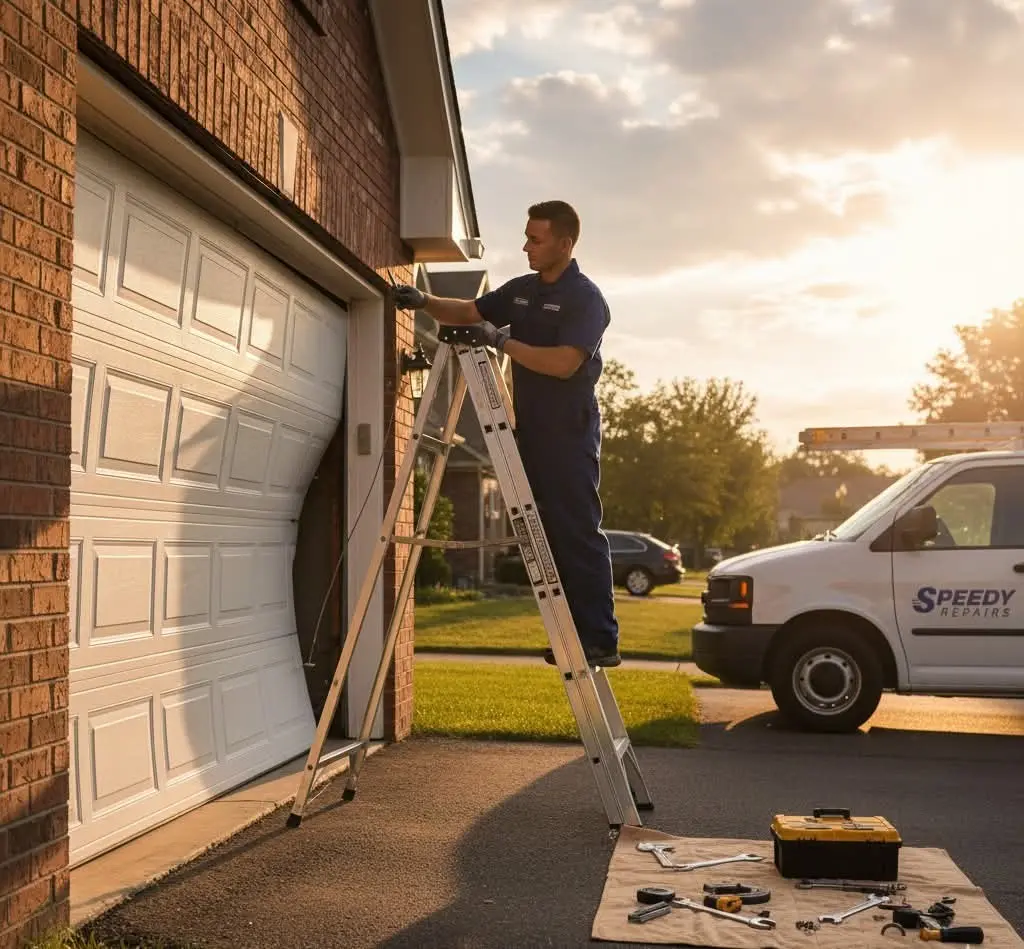
This one looks dramatic but is often fixable. A door comes off track when a roller pops out of the track channel, usually because a roller failed or because something hit the door.
If the door is only slightly off track and still mostly up, you can sometimes coax it back by loosening the track bolts, nudging the track back into alignment, and then retightening. But if the door has dropped significantly or is visibly bent, stop. A severely off-track door is under uneven tension and can fall suddenly.
In my experience, about 60% of off-track doors in Hopkins are caused by a single failed roller, not an impact. That’s actually good news, because roller replacement resolves the root cause and prevents recurrence.
5. Opener Motor Runs But Door Doesn’t Move
This almost always means one of two things. Either the drive mechanism (chain, belt, or screw) has failed, or the opener’s carriage has disconnected from the door. The carriage is the plastic or metal trolley that slides along the drive rail and connects to the door arm.
Check whether the emergency cord was recently pulled. If the carriage disconnected from the drive, it won’t re-engage automatically on some older models. You may need to pull the cord in the opposite direction while the opener runs to snap it back into place.
If the drive chain or belt is broken, that’s a parts replacement job. Chains cost about $15 to $25 in parts. Belts run a bit more. The labor is moderate, since you have to thread the new drive through the rail, but it’s manageable for a mechanically confident homeowner.
6. The Door Reverses Before Closing or Immediately After Opening
Your opener has two adjustment limits: one that tells it how far to travel when opening, and one for closing. If the close-limit is set too short, the door will think it hit the floor before it actually does, and reverse.
Most LiftMaster and Chamberlain openers have two dials or screws on the motor head labeled “Up” and “Down” or “Open” and “Close.” Turning the close-limit screw a few clicks in the appropriate direction usually solves this in under five minutes.
If the door reverses upon sensing resistance rather than reaching a limit, check for an obstruction in the path of the safety sensors, or check whether the door itself is binding on the tracks. A door that drags or catches will trigger the auto-reverse safety feature intentionally.
Garage Door Opener Brands Common in Hopkins: An Honest Assessment
I’ve installed and repaired dozens of openers across the Hopkins area. Here’s what I actually think.
LiftMaster 8500W is the best wall-mount opener on the market for attached garages where ceiling clearance is an issue. It’s quiet, powerful, and the myQ connectivity works reliably. Retail around $300 to $350.
Chamberlain B4545T is the best mid-range belt drive for most Hopkins homeowners. Reliable, quiet, and the battery backup saved multiple customers during the 2023 power outages we saw after the spring ice storms. Runs about $230 to $280.
Genie ChainMax 1000 is the budget chain drive I recommend when cost is the primary concern. It’s loud compared to belt drives, but it’s extremely durable and the parts are easy to find locally at Menards on Excelsior Boulevard or at the Home Depot in St. Louis Park.
I’d steer most people away from the no-name openers sold at big-box stores under house brands. The warranty support is minimal and replacement parts can be impossible to source within two years of purchase.
What Hopkins Homeowners Should Do Before Winter Every Year
This is the maintenance checklist I’ve given to clients for years. Do this every October.
Start by testing the auto-reverse function. Place a two-by-four flat on the ground in the door’s path and let the door close on it. The door should reverse within two seconds of contact. If it doesn’t, adjust the down-force sensitivity on your opener before the ground freezes, because a frozen threshold creates constant resistance all winter and triggers this system constantly.
Next, lubricate every moving metal part. Hinges, roller stems, the torsion spring coils, and the bearing plates on each end of the torsion shaft. Use a proper garage door lubricant like 3-IN-ONE Professional Garage Door Lubricant. Skip the chain or belt drive itself, they don’t need lubrication.
Check the weatherstripping along the bottom and sides of the door. Cracked or brittle weatherstripping lets in cold air and moisture. A full replacement set costs about $25 at Menards and takes about 30 minutes. This single step can meaningfully reduce heating costs in attached garages.
Finally, clear debris from the tracks and visually inspect every roller. Any roller with a cracked or wobbling wheel should be replaced before cold weather sets in.
How Much Does Garage Door Repair Cost in Hopkins MN?
Prices as of early 2025, based on local service calls in the Hopkins and Minnetonka area:
Single torsion spring replacement: $150 to $250. Double springs: $200 to $350. Roller replacement (full set): $80 to $150 for labor plus parts. Track realignment: $75 to $150. Opener replacement (labor only): $75 to $100, plus the cost of the unit. Sensor replacement: $50 to $100 per sensor.
Most reputable local companies charge a $50 to $75 service call fee that applies toward any repair completed on the same visit. If someone quotes you a service call fee with no credit toward work performed, call someone else.
One thing I always tell homeowners: get a second opinion on spring jobs if the first quote seems high. Springs are the most commonly inflated repair in this industry.
FAQ: Garage Door Repair in Hopkins MN
How long does a garage door spring last in Minnesota? A standard torsion spring is rated for 10,000 cycles. One cycle is one open and one close. Most households use the door four to six times daily. That works out to roughly seven to fourteen years. Cold climates shorten spring lifespan by increasing metal fatigue, so expect closer to the lower end of that range in Hopkins.
Can I repair a garage door spring myself? You can replace extension springs with proper precautions and the right winding bars. Torsion spring replacement requires winding bars and specific knowledge of tension management. I do not recommend it for first-timers. The savings are real, but so is the risk.
Why does my garage door open slowly in winter? Cold thickens the lubricant on your rollers and hinges, increases spring tension requirements, and can cause the weatherstripping to freeze to the threshold. Lubricate in the fall and ensure your opener’s force settings are calibrated for winter conditions.
How do I know if my garage door needs to be replaced instead of repaired? If your door has significant panel damage, if the tracks are severely bent, or if the total repair estimate exceeds 50% of the cost of a new door, replacement is usually the smarter financial decision. A new steel door in Hopkins typically runs $700 to $1,500 installed, depending on insulation rating and style.
What should I do if my garage door won’t open during a power outage? Pull the red emergency release cord hanging from the opener rail. This disconnects the carriage and allows you to lift the door manually. If the door is heavy or won’t stay up on its own, your springs may be weakened. Do not leave the door open and unattended in that condition.
Is it worth getting a smart garage door opener in Hopkins? Yes, with one caveat: make sure the Wi-Fi signal in your garage is reliable. The myQ system built into LiftMaster and Chamberlain openers is genuinely useful for checking whether you left the door open while away from home. During the polar vortex events we get in Minnesota, remote monitoring can prevent frozen pipe damage caused by an accidentally open garage.
Why does my garage door shake when it moves? Shaking usually means rollers or hinges are worn, or that the door itself is out of balance. Disconnect the opener and manually lift the door halfway. If it stays in place, the springs are balanced. If it falls or rises on its own, the spring tension needs adjustment.
The One Thing Most Garage Door Guides Won’t Tell You
Here it is: most garage door problems are slow-motion failures, not sudden ones.
The squeaking that started three months ago was a warning. The slight slowness when the temperature dropped below 20°F was a data point. The occasional reversal was a symptom.
Homeowners who address these early signals spend an average of $50 to $100 per year on maintenance. Homeowners who ignore them face $300 to $600 emergency repair bills, usually on the coldest morning of February.
Hopkins has excellent local technicians if you need professional help. But understanding what’s happening with your door, what the noises mean, which repairs are DIY-friendly and which are genuinely dangerous, means you’ll never be taken advantage of and never be stranded with a car trapped in a frozen garage.
Your door is telling you something right now. It’s worth listening.
What’s the most persistent problem you’ve dealt with on your garage door? Drop it in the comments and I’ll give you a real answer.