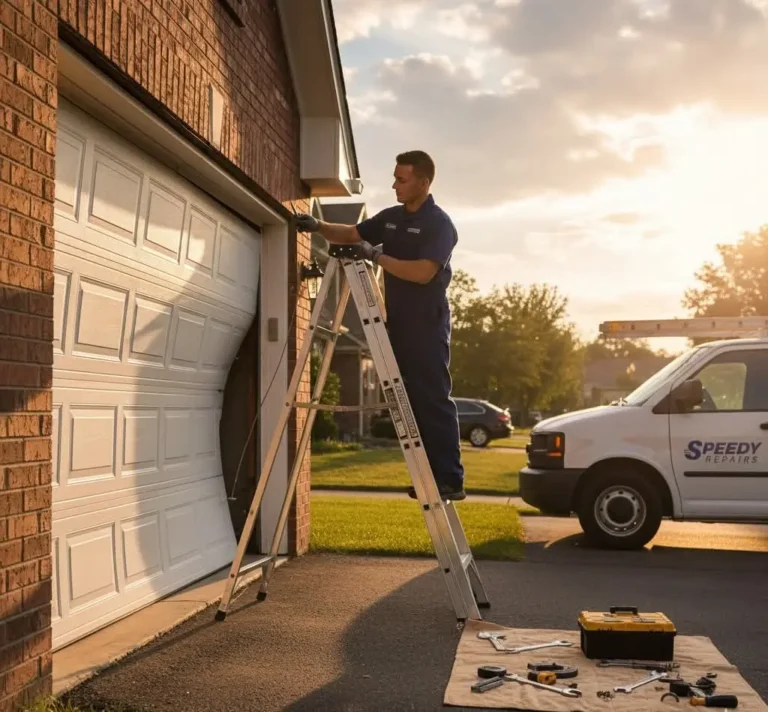
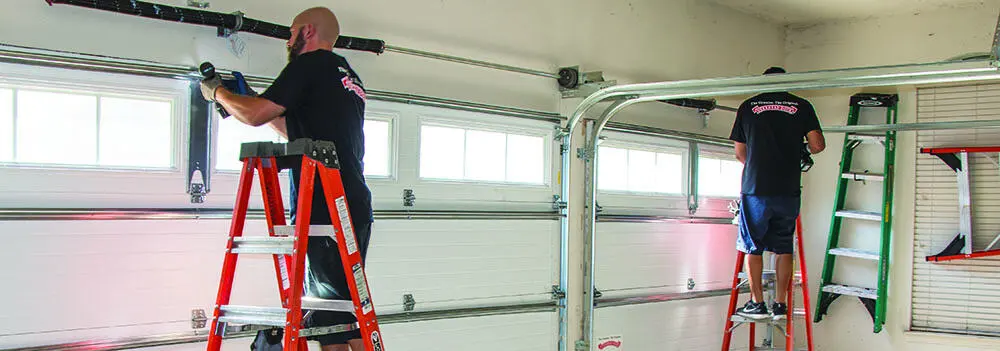
EMERGENCY GARAGE DOOR REPAIR IN HOPKINS, MN,What to Do First — A Hopkins Homeowner’s Guide
Updated 2026 | Local Pricing | Minnesota Winter Tips | Safety-First Approach
It was 6:47 on a January morning in Hopkins. Temperature outside: minus eleven. Sarah had a 7:30 AM meeting downtown and her garage door had just made a sound like a gunshot — then refused to move. Her car was inside. The door hung at a slight angle, heavy and completely unresponsive. She did what most people do in that moment: she grabbed the bottom of the door and tried to yank it open.
That was the wrong move. And it nearly cost her a broken wrist.
Emergency garage door situations happen fast and they feel disorienting. You’re running late, you’re stressed, and the one thing standing between you and your day is a 200-pound door that won’t cooperate. In that moment, most people make at least one mistake that either injures them, damages the door further, or turns a $200 repair into a $1,500 replacement.
This guide is for Hopkins homeowners who are in that moment right now — or want to be prepared before it happens. We’ll cover exactly what to do in the first five minutes of a garage door emergency, which situations are genuinely dangerous versus just inconvenient, what repairs you can attempt yourself, what you absolutely cannot, and what emergency garage door repair costs look like in the Hopkins, MN market in 2026.
The most dangerous garage door emergency is the one where you don’t realize it’s dangerous. A door that ‘almost works’ is often the most risky — it’s the one people keep forcing until something gives out violently.
How Do You Know If It’s a Real Garage Door Emergency?
Not every garage door problem at an inconvenient hour is a true emergency. Knowing the difference matters — because calling an after-hours technician in Hopkins adds $50 to $100 to your bill. But waiting on something genuinely dangerous can cost you far more.
Situations That Can Wait Until Morning
Some garage door failures are frustrating, but safe to wait on. If any of these describe your situation, secure your home for the night and schedule a morning appointment:
- The opener remote stopped working but the wall button still functions
- The door is making more noise than usual but opens and closes completely
- One panel has a cosmetic dent but the door moves normally
- The opener light is out but the door operates fine
- The door feels slower than usual but reverses properly on the auto-reverse test
In each of these cases, the door is still functional and not posing an active safety risk. Use it carefully and get it looked at the next business day.
Situations That Cannot Wait — Act Immediately
These situations require you to stop using the door right now and either call for same-day service or secure the door in place until a technician arrives:
- You heard a loud bang — like a gunshot — from the garage area
- The door is visibly crooked or one side is higher than the other
- A cable is hanging loosely or lying on the garage floor
- The door dropped suddenly or faster than normal
- The door will not close at all and your home is exposed
- You can see a gap in any coil of the torsion spring above the door
- The opener is running but the door is not moving
- You smell burning from the opener motor
Sarah’s situation — that loud bang followed by a tilted, non-responsive door — was a broken torsion spring. That is the single most common true garage door emergency in Minnesota homes, and it accounts for the majority of emergency calls local Hopkins technicians respond to during winter months.
The First 5 Things to Do When Your Garage Door Fails
Before you call anyone, before you touch the door again, run through these five steps in order. They take less than three minutes and they protect both you and the door from further damage.
Step 1: Stop Using the Door Right Now
This sounds obvious but it is the step people skip most often. The instinct is to keep pressing the button, keep trying to force the door, keep hoping it will cooperate. Every additional attempt on a failed door risks making the problem significantly worse — and more expensive.
If the door is in the down position, leave it down. If it is partially open, do not try to close it manually unless you are certain it is safe to do so. A door with a broken spring has no counterbalance. If you release it from the opener trolley, it will drop with its full weight — which can be anywhere from 130 to 400 pounds depending on the door material and insulation.
Step 2: Check If the Opener Is the Problem
Before assuming the worst, rule out the simplest possibility: the opener itself. Try operating the door from the wall button if you’ve been using only the remote. If the wall button works and the remote doesn’t, you have a dead remote battery — not an emergency.
Check the power. Opener units sometimes trip their own internal breaker during cold weather or power surges. Look for a reset button on the motor unit and press it once. If the opener hums but the door doesn’t move, the trolley may have disengaged. If the opener runs completely silently with no humming, check whether it has power at all.
Step 3: Use the Manual Release Safely
Every garage door opener has a red emergency release cord hanging from the trolley rail. Pulling this cord disconnects the door from the opener, allowing manual operation. This is your first option when the opener fails and you need to get your car out.
However, there is one critical rule: only pull the manual release when the door is fully closed. If the door is open and the spring is broken, pulling the release means the door will no longer be held up by the opener trolley. A door in that condition can fall. Pull the cord only with the door in the down position, then lift manually and test whether it feels balanced. A properly balanced door lifts smoothly and stays put at waist height when you let go. A door that shoots up or slams down has a spring problem.
NEVER pull the manual release on a door that is open if you suspect a broken spring. The door may drop suddenly with its full weight. Keep the door closed and call a technician.
Step 4: Secure Your Home If the Door Won’t Close
A garage door that will not close is a home security issue, full stop. If you cannot get the door to close — either through the opener or manually — you need to take temporary measures to secure the garage while you wait for a technician.
If the door can be pulled down manually even without the opener, do that and secure it using the manual lock bar on the inside of the door. If the door is stuck partially open or will not stay in the down position, use locking pliers clamped onto the track just below a roller to prevent the door from moving upward. This is a temporary measure only — do not leave it in this state for more than 24 hours.
If access from the garage to the home interior is possible, make sure that interior door is locked. Your garage is less secure than your front door at the best of times. With the garage door compromised, treat the interior door as your primary security barrier.
Step 5: Document the Damage Before Calling Anyone
Take three or four photos with your phone before you call a technician. Photograph the spring area above the door, the cables on both sides, the track and rollers, and any visible damage to panels. This takes 60 seconds and pays dividends in two ways.
First, a good technician can often give you a more accurate estimate over the phone when you can describe or send photos of what you are seeing. Second, if the damage was caused by a vehicle collision, a storm, or any event that might involve an insurance claim, documentation from immediately after the incident is valuable.
The Most Common Garage Door Emergencies in Hopkins Homes
After talking with technicians serving the Hopkins and broader Hennepin County area, four problems account for the vast majority of emergency calls. Here is what you need to know about each one.
Broken Torsion Spring — the Number One Emergency Call
Torsion springs are the horizontal steel coils mounted above the garage door opening. They store mechanical energy when the door closes and release it to counterbalance the door’s weight when it opens. A standard residential torsion spring is rated for approximately 10,000 cycles — one cycle being one open-plus-close sequence. A household using the door four times daily reaches that limit in roughly seven years.
When a torsion spring breaks, it almost always makes a loud bang that sounds like a gunshot or a firecracker. The door will then feel impossibly heavy or will not move at all. In some cases the door will be visibly tilted because the spring on one side broke while the other remained intact.
Torsion spring replacement is the single repair that trained technicians are most adamant homeowners should never attempt themselves. The spring must be fully unwound before removal, which requires specialized winding bars and significant physical force. An amateur attempting this without the right tools risks the spring releasing suddenly with potentially catastrophic force. Professional torsion spring replacement in Hopkins runs between $150 and $300, including both springs — because you always replace both at once.
Door Off Track — More Dangerous Than It Looks
A garage door that has come off its track is one of the most deceptive emergencies, because it sometimes looks almost normal. The door may open and close partway, or one side may be riding smoothly while the other has jumped the rail. The danger is that the door is now moving in an uncontrolled way, and every cycle increases the stress on the remaining track contact points.
A door can come off track for several reasons: a vehicle hitting the door from inside or outside, a broken roller that allows the door to shift, a severely bent track section, or a cable failure that causes one side to drop faster than the other. In Hopkins garages that are used heavily through winter, track misalignment from temperature expansion and contraction is also a contributing factor.
Do not attempt to ride the door back onto the track yourself by forcing it. The tracks are precise aluminum channels, and forcing a misaligned door risks bending them permanently — turning a $150 roller replacement into a $400 track replacement. Call a technician and leave the door in the down position.
Snapped Cable — Never Ignore This One
Garage door cables are the steel wires that connect the door to the spring system and wrap around the cable drums at each side of the door. They are under significant tension whenever the door is in use. A snapped cable causes the door to drop on the affected side, creating that characteristic tilted appearance that Hopkins homeowners describe as ‘one side lower than the other.’
If you can see a cable lying loosely on the garage floor, hanging from the drum, or visibly frayed, stop using the door immediately. A door operating with one functional cable places enormous stress on the remaining cable, the tracks, and the opener — and the second cable failure typically follows quickly. Cable replacement in Hopkins costs between $100 and $200 and should always be done in pairs.
Door Won’t Close in Winter — a Hopkins Special Problem
This one is uniquely common in Minnesota, and it catches Hopkins homeowners off guard because it happens most often during the first hard freeze of the season. The bottom weather seal — the rubber strip along the bottom edge of the door — freezes to the concrete floor of the garage. When the opener tries to raise the door, it strains against the frozen seal.
Three things can happen: the opener motor burns out trying to overcome the resistance, the weather seal tears away from the door, or the bottom panel of the door buckles from the stress. None of those outcomes is cheap. The correct response is to thaw the seal before operating the door. A heat gun works best. Warm water poured along the seal line works if you don’t have a heat gun. Never use boiling water on a frozen concrete floor in winter — the thermal shock can crack it.
What You Can Fix Yourself vs. What Needs a Pro
Here is the honest breakdown. There are legitimate emergency fixes a Hopkins homeowner can attempt safely, and there are repairs that will injure you if you try them without training and proper tools. Knowing the line between these two categories is the most valuable thing in this guide.
DIY vs. Professional Repair Guide
Wiping sensor lenses clean | Broken or visibly gapped torsion spring |
Re-aligning photo-eye sensors | Any work involving cables or drums |
Lubricating rollers and hinges | Door off track on one or both sides |
Replacing remote control battery | Door that fell or dropped suddenly |
Manually releasing the opener | Opener making grinding or burning smell |
Thawing frozen bottom seal (heat gun) | Any repair requiring spring winding bars |
Table: Quick reference for emergency repair decisions. When in doubt, call a pro.
Safe DIY Fixes in an Emergency
Sensor cleaning and alignment is something any homeowner can handle. The photo-eye sensors sit about six inches off the ground on both sides of the door opening. If they are misaligned or dirty, the door will not close. Wipe the lenses with a clean cloth and check that the indicator lights on both sensors are solid — not blinking. If they are blinking, loosen the mounting bracket wing nut and adjust the sensor until the light becomes solid, then retighten.
Lubricating the rollers, hinges, and torsion bar is also safe and often solves noise and sluggishness issues. Use a lithium-based grease such as WD-40 Specialist White Lithium Grease. Apply it to all metal-on-metal contact points: rollers, hinge pins, the torsion bar, and the top of the rail. Do not lubricate the tracks themselves — that causes the rollers to slip.
Repairs That Will Injure You If You Try Them Alone
Torsion spring replacement tops this list and it is not close. If you search YouTube you will find videos of homeowners attempting this repair. You will also find, if you look deeper, forum posts from emergency rooms and orthopedic surgeons describing the injuries that result when it goes wrong. The stored energy in a torsion spring can launch a winding bar across a garage with enough force to cause serious facial and skeletal injuries. Do not attempt this repair.
Cable replacement falls into the same category. Cables are connected to the spring system, and replacing them requires releasing and re-tensioning spring energy. The tools required — winding bars, cable tensioning equipment — are not available at Home Depot for a reason.
Emergency Garage Door Repair Costs in Hopkins, MN (2026)
One of the most common questions Hopkins homeowners ask when calling for emergency service is: how much is this going to cost? Here is the current market reality for the Hopkins and broader Twin Cities west metro area, based on 2025 service call data.
2026 Emergency Repair Cost Guide — Hopkins, MN
Broken torsion spring | $150 – $300 | HIGH — same day |
Door off track | $125 – $250 | HIGH — stop using it |
Snapped cable | $100 – $200 | HIGH — do not force open |
Opener motor failure | $200 – $400 | MEDIUM — use manually |
Bent/damaged panel | $200 – $500 | MEDIUM — cosmetic first |
Frozen bottom seal | $0 – $80 | LOW — DIY often works |
Sensor malfunction | $75 – $150 | MEDIUM — safety risk |
Broken rollers/tracks | $100 – $200 | MEDIUM — worsens fast |
Table: Approximate 2025 pricing for Hopkins, MN area. Costs vary by company, parts brand, and time of service.
Typical Price Ranges by Problem Type
The service call fee alone in the Hopkins market runs between $75 and $125 for standard business hours. Emergency or after-hours calls — evenings, weekends, and holidays — typically add $50 to $100 on top of that base fee. This is the flat rate just for a technician to show up and assess the problem. Parts and labor are additional.
For the most common emergency, a broken torsion spring, total repair cost including the service call, two new springs, and labor runs between $225 and $400 in the Hopkins area. For context, a full garage door replacement for a standard 16-foot wide single door with basic insulation starts around $1,200 installed. Most spring repairs are worth doing rather than replacing the whole door, unless the door itself has significant age or panel damage.
Why After-Hours Calls Cost More — and How to Avoid It
After-hours service is a real cost driver for Hopkins homeowners, and it is worth understanding why. Technicians who respond to weekend and late evening calls are typically on a premium rate, and the companies that offer true 24-hour service carry higher overhead to maintain that availability. The $50 to $100 premium is legitimate.
The best way to avoid after-hours charges is also the least exciting: annual maintenance. A professional tune-up and safety inspection, which runs between $100 and $175 in Hopkins, catches worn springs, fraying cables, and failing rollers before they become 6 AM emergencies. Most Hopkins technicians will tell you that the majority of their emergency calls involve components that were already showing signs of wear — they just went uninspected.
A $125 annual inspection prevents most $300 emergency calls. More importantly, it prevents the injuries that happen when homeowners deal with failed components on their own at six in the morning when they’re rushing to work.
Minnesota Winter Emergencies — What Hopkins Homeowners Face
Hopkins sits in Hennepin County, where winters are long, cold, and genuinely brutal on mechanical systems. Garage doors in Minnesota age faster than the national average because they cycle through temperature extremes that coastal homeowners never experience. Here are the three winter-specific emergencies that Hopkins technicians see every season.
Frozen Bottom Seal — What to Do Right Now
If your door is frozen to the ground, here is the correct sequence. First, do not press the opener button. Do not try to pry the door up from the outside. Both of these approaches damage either the opener motor or the bottom seal, and sometimes both.
Use a heat gun set to medium heat and work it slowly along the bottom edge of the door where it meets the concrete. Move the gun continuously — holding it in one spot can damage the rubber seal or crack the concrete. If you do not have a heat gun, pour warm (not boiling) water along the seal line from a pitcher or watering can. Give it 60 to 90 seconds to work, then try lifting the door manually by grasping the bottom bar and lifting straight up. Once it breaks free, operate it normally.
After the emergency is resolved, consider applying a silicone-based lubricant to the bottom seal before the next freeze. This significantly reduces the chance of it bonding to the concrete again. Do not use WD-40 on rubber seals — it degrades the rubber over time.
Spring Failure in Cold Weather — Why It Happens More in Winter
Metal contracts in cold temperatures. A torsion spring that is properly tensioned at 60 degrees Fahrenheit will be slightly over-tensioned at minus ten — because the coils have contracted, tightening the wind. Over thousands of cold-weather cycles, this repeated stress accelerates metal fatigue at a rate that surprises most homeowners.
This is why spring failures in Minnesota cluster in the coldest months, typically December through February, and why springs that were ‘fine last spring’ suddenly break on a January morning. It is also why the 10,000-cycle rating on springs is conservative — Hopkins homes using their garage door four or more times daily in Minnesota winters may want to plan for spring replacement closer to the six-year mark rather than waiting for the seven-to-eight-year point.
Power Outage and No Opener — Manual Release Guide
Hopkins experiences power outages during winter storms, and a dead opener means a door you cannot operate electronically. Here is how to use the manual release correctly and safely.
- Make sure the door is fully in the down position before proceeding.
- Locate the red emergency release cord hanging from the trolley — the mechanism that rides along the ceiling rail. Pull the cord firmly downward. You will hear or feel a click as the trolley disengages.
- Lift the door from the bottom, using the handle or gripping the bottom bar with both hands. Lift straight up — do not angle or twist.
- If the door lifts smoothly and stays open at waist height when you let go, the spring tension is correct. If it drops immediately, do not use the door — the springs need adjustment.
- To re-engage the opener after power is restored, simply pull the release cord again (some models require pulling toward the door rather than straight down to re-engage) or press the wall button — the trolley will reconnect automatically on most modern openers.
If your opener does not have battery backup and you deal with regular winter outages, this is the best upgrade available for approximately $250 to $320 installed. LiftMaster’s 8550WLB and Chamberlain’s B6765 both offer integrated battery backup providing roughly 20 manual cycles during an outage — more than enough to get through a typical storm.
Who to Call for Emergency Garage Door Repair in Hopkins, MN
When you need emergency service, you do not have time for extensive research. Here is what to look for in the first 90 seconds of your search, and the specific questions to ask before you agree to a technician coming out.
What to Ask Before You Hire Anyone
Four questions separate reputable Hopkins-area garage door companies from the ones that will overcharge you or send out an undertrained technician:
- Do you charge a flat service fee or is the diagnosis included in the repair cost? Legitimate companies are transparent about their service call fee upfront.
- Are your technicians IDA certified? The International Door Association certification requires demonstrated technical knowledge. Not every good technician has it, but asking signals that you know what good service looks like.
- Do you replace both springs when one breaks? If a company says they will replace only the broken spring to save money, find another company. Springs are always replaced in pairs.
- Can you give me an estimate over the phone if I send photos? A technician who can give you a ballpark range based on photos is confident in their diagnostic ability and is not trying to upsell you after arriving.
Reputable companies serving the Hopkins area include JB’s Door Service, Overhead Door of the Twin Cities, and Eden Prairie Garage Doors, which covers the Hopkins market. For true 24-hour emergency response, confirm availability before assuming — not every company that lists emergency service actually staffs it around the clock.
Red Flags to Avoid in Emergency Situations
Emergency situations make homeowners vulnerable to bad actors, and the garage door industry has its share of companies that exploit urgency. Watch for these warning signs:
- A company that quotes an unusually low service fee ($29, $39) — they make it back on inflated parts pricing
- A technician who insists your door needs full replacement when only one component failed
- A quote given without the technician actually seeing the door or its components
- Pressure to approve a full repair immediately without time to review the itemized cost
- A company with no local Hopkins or Twin Cities area address on their website
If something feels off, it probably is. A legitimate technician will give you a written estimate, explain what failed and why, and not pressure you to decide in the moment. You are entitled to ask for time to review the quote — even in an emergency.
Frequently Asked Questions
My garage door made a loud bang and now won’t open. What happened?
Almost certainly, you have a broken torsion spring. The loud bang is the sound of the spring releasing its stored tension when it snaps. Do not attempt to operate the door. Leave it in the down position, do not pull the manual release while it is closed unless you plan to leave it down, and call a garage door technician for same-day service. This is the most common true emergency in Hopkins homes and a straightforward repair for a professional.
Can I drive my car out if one cable snapped?
No. A door with a snapped cable is structurally compromised and can drop suddenly or come off the tracks if operated. The cable failure means one side of the door has lost its counterbalancing support. Forcing the door open risks it falling onto your vehicle — or you. Leave the car inside and call for service. Most Hopkins technicians can respond within two to four hours for cable emergencies.
How much does emergency garage door repair cost in Hopkins at night or on weekends?
Expect to pay the standard service call fee of $75 to $125 plus an after-hours surcharge of $50 to $100. So your minimum cost for a technician to show up is typically $125 to $225 before any parts or labor. The actual repair adds on top of that. For a broken spring after hours, total cost in Hopkins generally runs $300 to $450 all in.
Is it safe to leave my garage door partially open overnight?
It depends on the situation. If the door is stuck open and cannot be closed, your priority is security. Use locking pliers clamped onto the track below a roller to prevent the door from moving further, lock the interior door between the garage and home, and call for morning service. Do not leave a partially open garage door unattended if it can be prevented — it is both a security and a safety issue.
My door reverses immediately every time I try to close it. What is wrong?
The most common causes are dirty or misaligned photo-eye sensors, or the door’s close-force setting is too sensitive. Start by wiping the sensor lenses and confirming the indicator lights on both sensors are solid. If the door still reverses, check whether anything is blocking the sensor beam path — even a spider web can trigger it. If cleaning and clearing the path does not solve it, the force adjustment or limit settings on the opener may need professional calibration.
How do I know if my garage door opener needs to be replaced versus repaired?
Age is the main indicator. Openers older than 15 years lack current safety features and often cost as much to repair as to replace. If your opener predates 1993, it lacks legally required photo-eye sensors — replace it. If it is making a burning smell, if the motor runs but the chain or belt does not move, or if it cannot be repaired with standard parts, replacement is the better investment. New openers in the Hopkins market run $300 to $500 installed for a quality unit with modern safety features.
Can a garage door fall on someone if the spring breaks?
Yes, potentially. A door without functional springs has no counterbalance. Most modern opener systems include a trolley that prevents free-fall, but if the door is disconnected from the opener and the spring has failed, it can drop with its full weight. This is why the rule is absolute: do not pull the manual release on a door that is open or partially open if you suspect spring failure. The weight of even a standard residential door is enough to cause serious injury.
How long do garage door springs last in Minnesota?
Most residential torsion springs are rated for 10,000 cycles — roughly seven years for a household using the door four times daily. Minnesota’s temperature extremes accelerate metal fatigue, so Hopkins homeowners should plan for spring replacement closer to the six-year mark. If your springs have never been replaced and your door is eight or more years old, schedule a professional inspection before the next winter season. Springs rarely give warning before they break.
Don’t Wait — A Small Problem Becomes a Big Emergency Fast
Sarah, the Hopkins homeowner from the opening of this guide, eventually got her car out — but not before waiting two hours for an emergency technician on a morning she could not afford to lose. The broken torsion spring cost her $280 to repair. The rental car she needed for her morning meeting cost another $65. The total tab for skipping her annual maintenance inspection: $345 and a very stressful morning.
Her technician told her the spring had been showing stress fractures that would have been visible during a professional inspection. The break was not a surprise. It was a prediction that nobody made.
The five steps in this guide — stop using the door, check the opener, use the manual release safely, secure your home, document the damage — will protect you in the moment. But the real lesson Hopkins homeowners take away from emergency situations is almost always the same: annual maintenance prevents most of them.
If your garage door is more than six years old, if the springs have never been replaced, or if you cannot remember the last time a technician looked at the system, schedule a safety inspection before winter arrives. In the Hopkins market, that inspection costs between $100 and $175 and takes about an hour. It is the most cost-effective garage door service you can purchase.
And if you are reading this in the middle of an emergency right now — stop, breathe, and follow the five steps. Do not force the door. Do not touch the springs. Document what you see, secure your home, and call a licensed Hopkins-area technician. The door will get fixed. The goal is to make sure you and your family are safe while that happens.
Have a garage door emergency in Hopkins right now, or questions about a situation not covered here? Describe what you’re seeing in the comments — or call our Hopkins service line directly. We respond to emergency inquiries seven days a week.
Emergency Garage Door Repair — Hopkins, MN | 2026 Local Guide
Safety-first guidance for Hennepin County homeowners